


![Jarvis Dining Chairs [Set of 2] [Faux Leather]](http://ofcasafurniture.com/cdn/shop/files/20260729154846.jpg?v=1785311411&width=104)
![Aoife Sleek Dining Chairs [Set of 2] [Linen Texture Fabric]](http://ofcasafurniture.com/cdn/shop/files/UDC8025_2.jpg?v=1777366607&width=104)
![Zahra Dining Chairs [Set of 2] [Boucle Fabric][⌀ 1.9 cm]](http://ofcasafurniture.com/cdn/shop/files/51_c6c2d8af-ba92-4c46-a677-4fe5804efb23.jpg?v=1789623459&width=104)
When decorating a dining room, many people spend far more energy choosing a table or picking out the right rug and treating the chairs almost as an afterthought. In reality, dining chairs are much more than just a place to sit. They are one of the most frequently used pieces of furniture in the home, quietly supporting countless everyday moments.
Think about the weeknight dinners that nobody photographs. The school-morning chaos with toast and forgotten homework. A long Sunday lunch, all of it happens in a chair you probably didn’t think much about when you bought it.
That is why choosing the right dining chair deserves more attention than it often receives. The best dining chair is not simply the one that looks beautiful. It should suit your lifestyle, fit comfortably within your space, support everyday use, and complement the overall design of your home.
In this guide, we'll walk you through everything you need to consider before buying dining chairs, including how to choose chairs based on your lifestyle, space planning, comfort, interior style, and practical buying considerations, helping you find the perfect dining chairs for your home.

Why Dining Chairs Matter More Than You Think?
Affecting Your Daily Usage Experience with Dining Chairs
A premium dining chair offers far more than just a temporary spot to sit. Well-crafted dining chairs let you enjoy effortless, natural comfort every time you dine, rather than forcing your body to awkwardly adapt to poorly designed seating structures.

Affecting the Overall Ambiance of Your Dining Space
Dining chairs serve as indispensable components in interior design. Their silhouette, proportions, hues and overall aesthetic can directly alter the visual perception of your dining area. Even with an exquisite dining table, mismatched proportions or clashing chair styles will disrupt spatial harmony and create visual clutter.On the contrary, well-matched dining chairs blend seamlessly with the surrounding decor to build a naturally cohesive dining environment.

Balancing Aesthetics, Comfort and Practicality
Top-tier dining chairs strike a perfect equilibrium among comfort, practical functions and visual design. When picking dining chairs, plenty of shoppers assume stylish appearances equal well-rounded performance and the best fit for their homes.Nevertheless, prior to making your purchase, you ought to sort out your actual demands rather than being led astray by product photos or fleeting popular trends. The most ideal dining chair is seldom the latest fashionable style. Instead, it is a design that caters to your daily use habits and harmonizes perfectly with your existing living space.

With that in mind, the next step is to analyze your personal lifestyle thoroughly.
How Do You Choose Dining Chairs Based on Your Lifestyle?
Here’s where most dining chair guide articles get it backwards. They start with aesthetics, colors, shapes, trends and treat lifestyle as a footnote. It should really be the other way around. The right starting point is “how do I actually use this space.”
Families with kids: Prioritizing Durability Alongside Comfort for Daily Use
Families with young children have vastly different priorities compared to couples who host dinner parties only a few times each month. For these households, dining chairs are much more than decorative furnishings. They are practical functional pieces enduring daily intensive use.
Juice spills, leftover pasta messes and crayon smudges on chair upholstery are not rare hypothetical issues — they are everyday realities. In homes with children, wipeable surfaces and tough, stain-resistant fabrics are far more important than meticulous colour matching.

Small-space homes: Maintaining an Airy & Light Feel Within Your Dining Area
Couples in smaller apartments are usually solving a different problem altogether, space efficiency and visual lightness. A bulky, heavily upholstered chair can dominate a compact dining nook in a way that feels claustrophobic rather than cozy. Slimmer profiles, lighter materials, and chairs that don’t visually anchor the floor as heavily tend to work better here.

Open-plan spaces: Creating Visual Harmony With Your Overall Home Decor
Open-plan homes introduce their own consideration: the dining area is rarely fully separate from the kitchen or living space, which means the chairs need to hold their own visually within a bigger, more varied room. They’re not hidden behind walls, they’re part of the whole sightline, which raises the stakes on getting the shape and tone right.
None of these scenarios are mutually exclusive, and the point is simply this: knowing your own patterns of use before you start browsing will save you from buying something beautiful that quietly doesn’t work for your life.

Understanding Different Dining Chair Styles
Once lifestyle is sorted, style becomes a much easier conversation, because now you’re choosing from a narrower, more relevant set of options rather than everything on the market.
What dining chairs suit modern-style interiors?
Modern-style design prioritises functionality, minimalism and visual order. It gains appeal not from ornate embellishments, but from premium craftsmanship reflected in furniture proportions, structural build and subtle finishing details.
If your home features Modern or Contemporary interior design, opt for dining chairs defined by clean lines, crisp outlines and well-balanced proportions. These seating pieces keep the space tidy and streamlined, whilst elevating overall texture via refined design touches.

What dining chairs work for natural minimalist interiors?
Homes leaning toward natural, minimalist, warm and cosy aesthetics can draw great inspiration from Scandinavian and Japandi design styles.
Scandinavian design centres on nature, practicality and everyday comfort, crafting laid-back, inviting atmospheres with straightforward designs. Japandi merges Japanese minimalism with Nordic living philosophies, highlighting tranquility, visual order and natural materials for a restrained, serene living vibe.
Rather than standing out as bold focal points, these chairs integrate gently with surrounding decor through organic design language, cultivating a soothing, balanced atmosphere for your dining zone.

What dining chairs work for warm and inviting interiors?
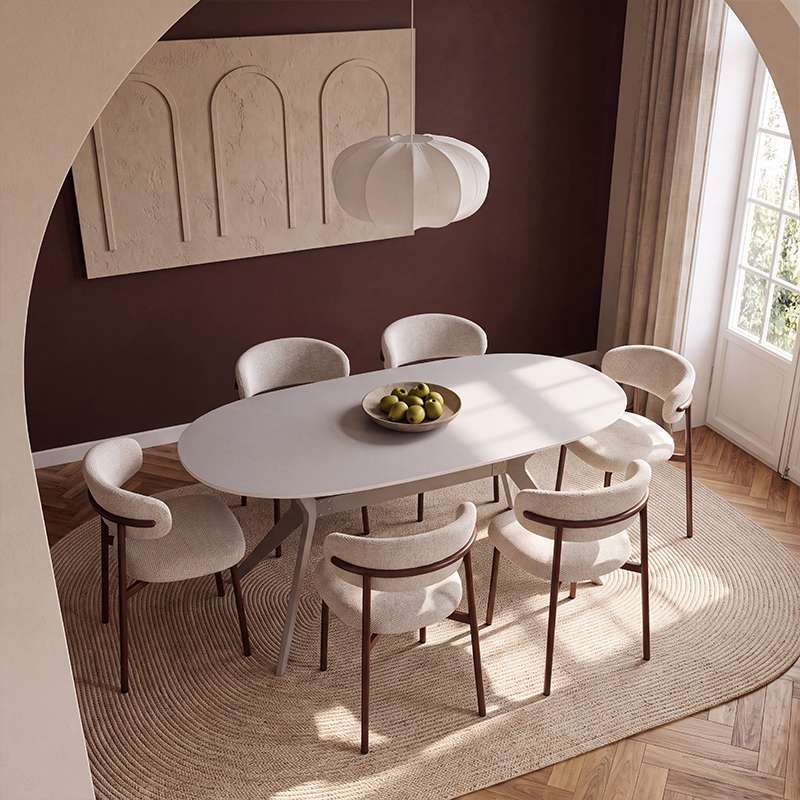
For homeowners craving a warm, comfortable dining area paired with sophisticated design and premium quality, Organic Modern and Soft Luxury are excellent styling options.
Organic Modern blends contemporary minimalism with natural elements. Soft curves, earthy hues and tactile textures prevent modern layouts from feeling stark or cold. Soft Luxury delivers elegance, cosiness and refinement, conveying high-end quality through premium materials and delicate workmanship.
Such chairs add softness and dimensional layers to your dining space. Your dining area will no longer merely serve meal functions, but turn into a cosy spot for family conversations, relaxation and savouring daily moments.

How Do You Choose Comfortable Dining Chairs?
Most people only judge dining chair comfort based on the softness of the cushion surface. Even so, genuine seating comfort never merely relies on soft cushion padding. True comfort stems from a combination of multiple factors: proportional sizing, ergonomic seat construction, bodily support structure, and alignment with your daily usage habits. A well-engineered dining chair holds your body in a naturally relaxed posture.
Seat Height and Seat Depth Matter So Much
Seat height needs to relate properly to table height, generally around 25 to 30 centimeters of clearance between the two. Too little, and your knees end up jammed under the table; too much, and you’re reaching awkwardly for your plate. Seat depth matters almost as much: somewhere between 44 and 50 centimeters tends to suit most adults, supporting the full length of the thigh without forcing you to perch on the edge or struggle to maintain a comfortable posture.

Backrest Support Affect Comfort Levels
Backrests bear the core responsibility of supporting your torso. Premium dining chairs do not require bulky padded backs; they deliver targeted ergonomic support to keep your spine neutrally relaxed while seated.
This is where a lot of attractive dining chairs quietly fall short. A backrest that only reaches the lower back leaves the upper body unsupported, which becomes noticeable after twenty or thirty minutes, exactly the point at which most dinners are just getting started. Chairs with a slightly taller back, or a gentle curve that meets the natural shape of the spine, tend to hold up much better over a long meal or a working session.

Do Not Pick Armchairs Blindly
Armrest dining chairs have grown increasingly popular in recent years. They supply extra support for your arms, relax your sitting posture and create an enveloping, cosy seating sensation.
Nevertheless, armrest chairs are not a universal fit for every household. Arm structures widen the overall footprint of dining chairs. Confirm the arm height can slide fully underneath your dining table before buying, otherwise storage and moving space will be restricted. Armrest dining chairs are ideal for spacious dining zones, formal dining layouts, or households spending long stretches seated at the table.

Pleasant user experience comes from holistic design balance rather than any single component. A comfortable dining chair features rational seat height, sufficient support for legs and backs, plus seamless coordination with table measurements, room layout and your daily lifestyle.
When dining chairs strike the perfect balance of comfort, aesthetics and practicality, they satisfy your daily dining demands and accompany you through warm family gatherings, friend get-togethers and every precious moment in daily life.
FREQUENTLY ASKED QUESTIONS
How many dining chairs should I buy?
Most people buy enough chairs to sit at their table comfortably, plus one or two extras for guests, stored elsewhere if space is tight. A six-seat table typically pairs well with six matching or coordinated chairs, with a couple of stackable spares kept for larger gatherings.
What dining chair style suits a small apartment?
Slimmer profiles, lighter materials, and chairs with visible metal or slender wooden legs tend to work best in compact spaces, since they don’t visually dominate the floor. Heavily upholstered armchairs can feel oversized in a small dining nook, even if only one or two are used as accent seats.
Do all my dining chairs need to match?
No. A coordinated approach, matching color palette but varying shape, or pairing armchairs at the ends with simpler side chairs, often looks more considered than a fully identical set, and gives you more flexibility over time.
FINAL THOUGHTS
Choosing Chairs That Actually Suit Your Life
There’s no universal answer to buying dining chairs, and any guide that promises one is probably oversimplifying things. The right choice depends on how you live, who you live with, how often your table fills up with people, and what kind of mood you want the room to carry.
What’s worth holding onto, though, is the underlying principle: comfort, durability, and proportion matter just as much as how a chair looks in a photograph, arguably more, since you’ll be living with the decision far longer than you’ll be admiring the picture. A chair that gets used, that holds up to real life, and that still feels good to sit in after a year or five, is a better investment than one that simply looks like the part on day one.
Take the time to sit in things. Measure before you commit. Think honestly about your household rather than an idealized version of it. And trust that the best dining chair isn’t necessarily the most striking one in the room, it’s the one that quietly does its job well enough that you stop thinking about it at all and start thinking instead about the people sitting around the table with you.

Leave a comment
This site is protected by hCaptcha and the hCaptcha Privacy Policy and Terms of Service apply.